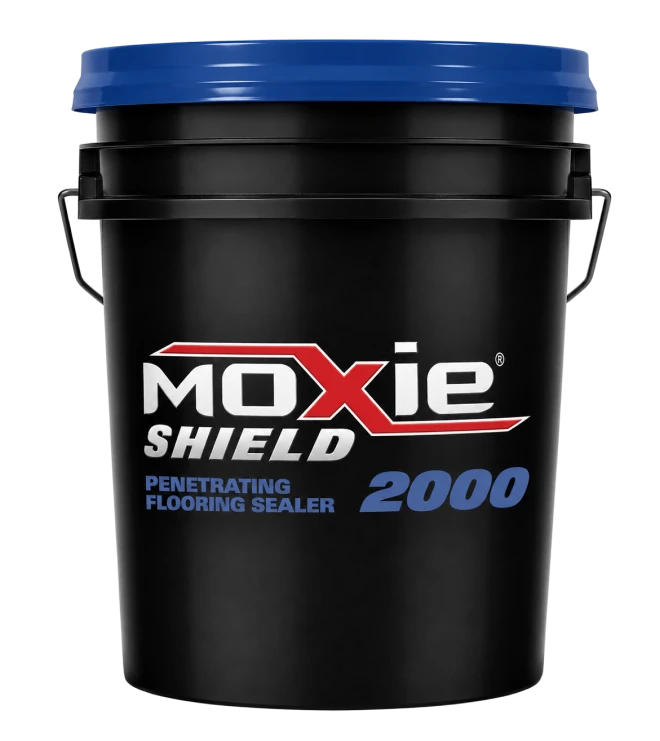

A permanent, penetrating sealer and hardener developed for flooring and specialty applications. It blocks water vapor migration and alkali efflorescence beneath flooring systems and impermeable surface treatments, ensuring long-term performance and stability.
Not sure about the amount? Try Material Calculator
Coverage Estimates
Technical Consultation Recommended
Coverage rates for this product depend on mix design, substrate conditions, and application method. For accurate quantities, we recommend speaking with our sales team before ordering.
Contact us at sales@moxieinternational.com or (916) 259-7990.
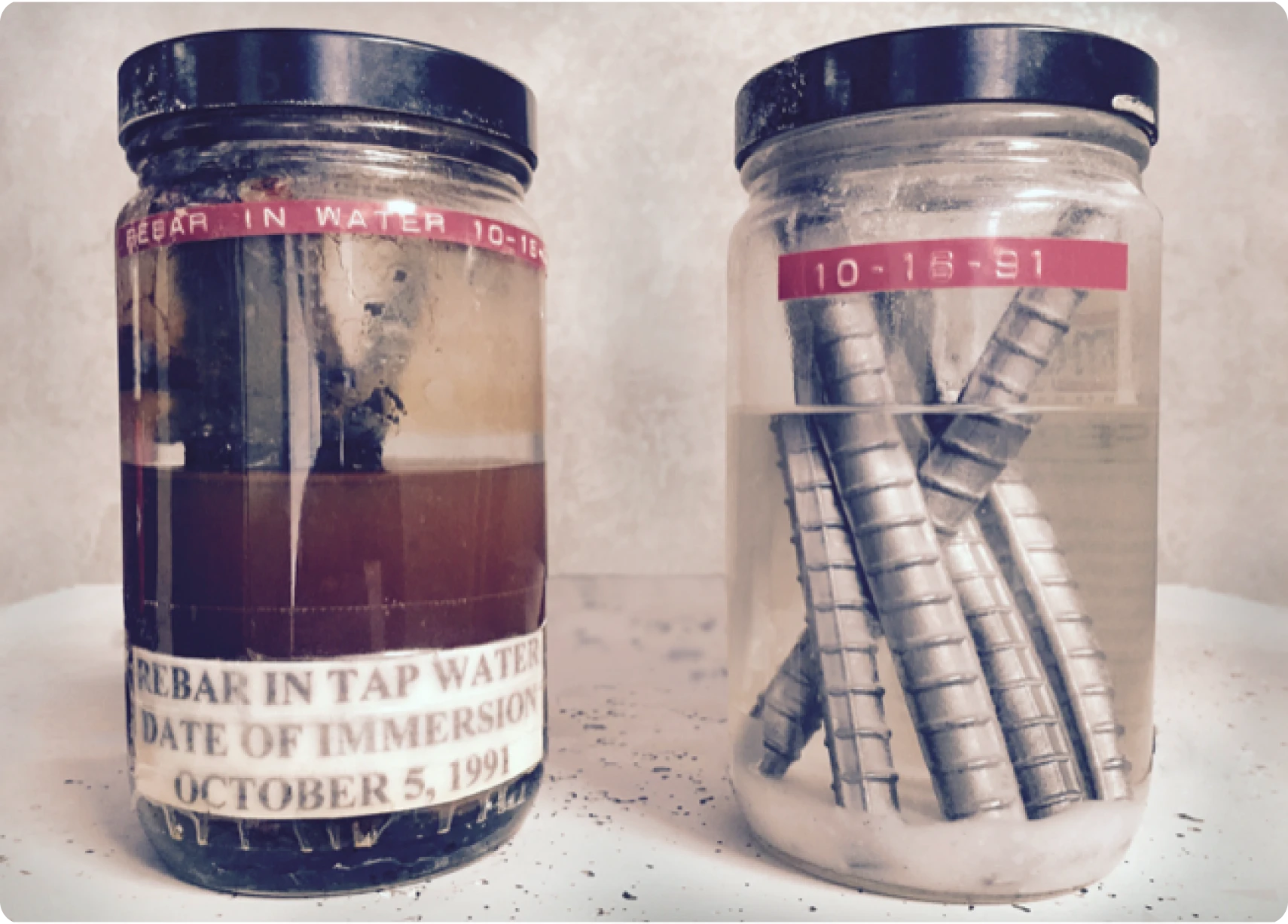

Moxie Shield 2000 Penetrating Flooring Sealer is suitable for new and existing concrete, penetrating up to seven inches to seal, protect and preserve concrete against moisture caused problems. A superior sealer against moisture for all above and below grade, as well as interior and exterior concrete.
Moxie Shield 2000 undergoes a complex chemical reaction by converting the by-products of cement hydration into a higher density cementitious material, creating an impermeable substrate. It dramatically enhances the natural characteristics of concrete by filling all pores and reducing the capillary voids to near zero.
Moxie Shield 2000 has been performing in laboratory and job-site settings for over 40 years and has demonstrated effectiveness incuring, surface hardening/strengthening, freeze-thaw durability and water vapor transmission.
Moxie Shield 2000 is available in 1 gal (3.8 L), 5 gal (18.9 L) pails, 55 gal (208 L) drums and 275 gal (1041 L) totes.
Substrate preparation is the most important factor when applying Moxie Shield 2000. Moxie Shield 2000 is a chemically reactive, penetrating sealer that MUST penetrate in order to be effective. [NOTE: Perform the Water Absorption Test* to verify absorption.] On existing slabs, remove any flooring materials, finishes, waxes, grease, surface sealers, paints, flooring adhesives, or any other materials that could impede the absorption and penetration of Moxie Shield 2000. If the concrete is nonabsorptive, it must be properly and aggressively abraded to expose a surface that will allow static absorption of our water-based product. Bead blast, scarify, or grind with a diamond blade to expose an absorptive surface. Acid etching is neither acceptable nor effective.
Store above 40oF in a tightly closed container. Do not allow product to freeze. Do not use compressed air, product may foam. Indefinite shelf life.
Prior to use, we would recommend consulting the product label, product technical data sheet, and SDS sheet. For your benefit, this information is included below.
Moxie Shield 2000 is a permanent penetrating sealer and hardener engineered specifically for the flooring industry and specialty applications. It shares the same densification chemistry as the 1500, but penetrates one inch deeper — up to 7 inches — and is formulated for the higher moisture vapor emission conditions encountered beneath flooring systems. Where the 1500 is a general-purpose deep-penetrating concrete densifier, the 2000 is purpose-built for the critical interface between concrete substrate and adhered or installed flooring. It carries a specific flooring industry warranty, documented flooring remediation protocols, and is specifically listed for efflorescence sequestration under installed floor coverings.
Moxie Shield 2000 is documented for normal-weight and lightweight concrete substrates receiving any surface-adhered floor covering — resilient flooring, hardwood, LVT, carpet, ceramic and porcelain tile, epoxy coatings, and other impermeable surface treatments. It is specifically engineered to stop moisture vapor transmission and alkali efflorescence attack beneath flooring materials — the two primary causes of flooring adhesive failure, seam separation, warping, curling, discoloration, mold, and bubbling. It is appropriate for both new concrete and existing slabs requiring remediation before flooring installation.
Yes. Moxie Shield 2000 is documented for above-grade and below-grade applications, including high subgrade moisture conditions and flooring remediation in basement and below-grade environments. It withstands hydrostatic pressure up to 100 psi — equivalent to 231 feet below grade. For architects specifying flooring over below-grade slabs, particularly in occupied spaces, it provides the substrate protection required to make flooring warranties viable in conditions where conventional moisture mitigation approaches fail.
An optional 12-year labor and materials warranty is available from Moxie International — the strongest warranty in the Moxie Shield product line and one that is specifically positioned to replace the flooring manufacturer’s warranty for moisture-related failures. The 12-year registered warranty is available through Moxie International directly and is not transferable through concrete producers, dealers, or distributors. For projects where flooring manufacturer warranties are at risk due to substrate moisture conditions, the Moxie 2000 warranty represents a direct contractual alternative. Contact sales@moxieinternational.com for warranty details and registration.
Moxie Shield 2000 undergoes a complex chemical reaction with the byproducts of cement hydration — specifically calcium hydroxide — converting them into a higher-density cementitious material that fills all pores and reduces capillary voids to near zero, creating an impermeable substrate. Penetration depth is up to 7 inches — one inch deeper than the Moxie Shield 1500 — and is the deepest penetration documented in the Moxie Shield line. This depth ensures the densification zone extends well beyond the carbonation front and any surface contamination layer, providing durable protection that cannot be removed by surface preparation, abrasion, or wear.
Coverage and coat requirements are directly tied to substrate moisture vapor emission rates. For standard concrete: two coats at 150 to 200 sq ft per gallon on the first coat, with the second coat using approximately half the first coat volume. For very porous concrete or high moisture vapor emissions of 12 lbs per 1000 sq ft per 24 hours up to 26 lbs per 1000 sq ft per 24 hours or higher, three or more coats are required — with longer chemical reaction and drying times between coats. These thresholds are critical for flooring installation scheduling and must be assessed before application planning. When absorption takes 30 minutes or longer per coat, no further applications are necessary.
The densified cementitious matrix formed by the 2000’s chemistry presents near-zero capillary porosity to penetrating agents. Marine chlorides, oil, gasoline, acids, and solvents all require capillary pathways or pore pressure to penetrate concrete — the elimination of these pathways by the densification reaction is what provides resistance. This broad chemical resistance profile makes the 2000 appropriate for flooring in industrial, automotive, food processing, and marine-adjacent environments where chemical spills, cleaning solvents, or atmospheric chlorides are ongoing exposure conditions.
Moxie Shield 2000 carries a comprehensive ASTM compliance suite: ASTM E96 (water vapor transmission), ASTM E1745 (water vapor retarders in contact with soil), ASTM F710 (preparing concrete floors for resilient flooring), ASTM C156 (water retention), ASTM C666 (freeze-thaw resistance — exceeds 600 cycles), ASTM C805 (surface hardness), ASTM D4263 (plastic sheet moisture test), ASTM D5084 (hydraulic conductivity), and ASTM C309 (curing compound performance). It also meets CARB requirements, EPA USDA VOC = 0, and is USDA approved for food processing areas. These standards collectively cover the full performance envelope from moisture vapor transmission to freeze-thaw durability to flooring substrate readiness.
This is a critical installation detail. Alkali salts (efflorescence), if present on the concrete surface at the time of or following treatment, will react with atmospheric carbon dioxide within 24 to 48 hours and become permanent calcium carbonates — a physical change that cannot be reversed chemically. If not removed before they harden, these salts require physical removal by wire brushing or grinding. Broom off any efflorescence that appears during and after the final water saturation step until none remain, confirm the surface is clean and dry, and do not install flooring until the process is complete and the slab is verified by ASTM E1907 testing.
Look for the documented indicators of moisture migration: spalling, dusting, structural joints and cracks; mats or boxes left on the floor becoming wet or damp quickly; and in slabs with prior flooring, evidence of efflorescence or alkali salts at flooring joints, chemical attack on adhesive bonds, warping, curling, cracking, seam separation, discoloration, mold or mildew, rusty nails in tack strips, bubbling, peeling, lumpy surfaces, or cracks visible through coatings. Any of these signs indicate active moisture migration that will compromise new flooring without treatment. Perform the Water Absorption Test to confirm absorptive substrate readiness before proceeding.
The Water Absorption Test verifies the substrate is absorptive enough for the product to penetrate and be effective. Pour two to three tablespoons of water onto the prepared concrete: if it spreads and absorbs within 15 to 20 minutes, the surface is ready. If water beads and shows no absorptive quality, the surface must be mechanically abraded before treatment. Bead blast, scarify, or grind with a diamond blade. Acid etching is not acceptable for the 2000. It is the contractor’s responsibility to provide an absorptive surface. Remove all existing flooring materials, coatings, waxes, grease, sealers, paints, and adhesives from existing slabs before testing.
Temperature and humidity: apply when ambient temperature is between 65 and 75 degrees F and humidity is 50% or lower. Do not apply below 65 degrees F. Step 1: perform the Water Absorption Test. Step 2: mist surface to dampen substrate, allow to dry. Step 3: apply first coat by low-pressure sprayer or pouring and brooming evenly — do not puddle in low areas; broom low areas first. Product must absorb and be dry to touch within 30 to 45 minutes. Step 4: apply second coat when surface is 90% dry. On very porous slabs or high moisture vapor emission conditions, three or more coats may be required. When absorption takes 30 minutes or longer, no further coats are necessary. Step 5: after final coat absorbs, mist with clean water. Step 6: 8 to 24 hours later, thoroughly saturate with clean water, broom out puddling, and allow to cure 48 to 72 hours or longer depending on initial moisture vapor emission rate. Step 7: broom off all efflorescence until none remain. When dry and efflorescence-free, proceed to ASTM D4263 and ASTM E1907 testing before installing flooring.
After the final water saturation step, broom off any efflorescence that appears and continue until none remain. This is not optional. Alkali salts present on the surface will react with atmospheric carbon dioxide within 24 to 48 hours and permanently convert to calcium carbonates — hard, crystalline deposits that cannot be removed chemically and require wire brushing or grinding. If flooring is installed over calcium carbonate deposits, they will continue to expand and compromise adhesive bonds and flooring integrity over time. Complete efflorescence removal before flooring installation is a warranty requirement.
Wait a minimum of 48 hours after the final water saturation step before installing flooring. After that waiting period, perform ASTM D4263 (Plastic Sheet Test) and ASTM E1907 (Relative Humidity Test). ASTM E1907 is the only acceptable moisture verification protocol per Moxie warranty requirements — ASTM F1869 (Calcium Chloride Test) and ASTM F2170 (electrical conductivity probe) are not acceptable as both produce erroneously high readings on treated concrete. Confirm adhesive manufacturer requirements for trowel notch depth, width, spacing, and pH levels. Ensure the adhesive specified is suitable for use over a non-porous, impermeable, nonabsorptive surface.
The optional 12-year labor and materials warranty from Moxie International is positioned as a direct replacement for the flooring manufacturer’s warranty for moisture-related failures — the single most common and costly category of flooring warranty claims. For flooring contractors and dealers, specifying Moxie Shield 2000 on every concrete substrate installation shifts the moisture liability from the flooring product to the substrate treatment, where it belongs. A treated slab with a 12-year Moxie warranty means that moisture-related flooring failures — adhesive bond loss, seam separation, mold, curling — are covered by a separate, dedicated warranty backed by Moxie International directly.
Any slab with moisture vapor emissions exceeding standard flooring adhesive tolerance thresholds — typically above 3 lbs per 1000 sq ft per 24 hours for many adhesive systems — creates a warranty risk for the flooring installation. Moxie Shield 2000 is specifically documented to address moisture vapor emissions from 12 lbs per 1000 sq ft per 24 hours up to 26 lbs per 1000 sq ft per 24 hours or higher. These are the conditions where conventional moisture mitigation products fail, where flooring warranties are voided, and where remediation costs are highest. The 2000 is engineered specifically for this problem space.
Yes. A CSI Specification Sheet is available for Moxie Shield 2000, enabling flooring contractors, specifiers, and dealers to include it in project specifications and submittal packages. The product is also supported by Application Procedures, an SDS, and warranty documentation. All are available upon request from Moxie International. Contact (844) 845-1975 or sales@moxieinternational.com to request documentation or discuss project-specific supply.
Moxie Shield 2000 is available in 1-gallon pails, 5-gallon pails, 55-gallon drums, and 275-gallon totes — covering projects from single-room residential remediation to large commercial flooring contracts. Contact Moxie’s sales team at (844) 845-1975 or sales@moxieinternational.com to discuss volume pricing and project logistics.
The leading cause of flooring failure in concrete buildings is moisture vapor migration from below — water vapor moving upward through the concrete slab, attacking adhesive bonds, feeding mold and mildew, and eventually destroying the flooring from underneath. Flooring manufacturers know this and routinely void warranties when substrate moisture levels exceed specified limits. Moxie Shield 2000 stops this at the source: it penetrates up to 7 inches into the concrete, reacts with the concrete’s own chemistry to eliminate the capillary pathways through which moisture travels, and creates a permanent, impermeable barrier between the slab and the flooring system above it.
On slabs with existing flooring: efflorescence or white mineral staining at flooring joints, failed adhesive bonds, warping, curling, cracking, seam separation, discoloration, mold or mildew growth, rusty nails in tack strips, bubbling, peeling, or lumpy surfaces visible under coatings. On bare slabs: mats or objects left on the floor becoming damp quickly, surface dusting, and spalling. Any of these are indicators of active moisture migration. Treating the slab with Moxie Shield 2000 before new flooring installation addresses the root cause rather than reinstalling over the same problem.
The optional 12-year labor and materials warranty is issued directly by Moxie International — not by concrete suppliers, dealers, or distributors. It is specifically positioned to replace the flooring manufacturer’s warranty for moisture-related failures, covering both product performance and associated labor. Contact sales@moxieinternational.com for complete warranty terms, registration details, and project-specific eligibility.
Moxie Shield 2000 is documented as a permanent penetrating treatment. Because it reacts chemically with the concrete matrix to form a higher-density cementitious material within the pore structure — rather than coating the surface — it does not wear, peel, or degrade over time. The protection is part of the concrete itself. The 12-year warranty reflects this permanence. For new flooring installations over treated slabs, no re-treatment of the substrate is required unless the surface is mechanically abraded through demolition or renovation.
Yes — flooring remediation is one of its primary documented applications. For existing buildings experiencing repeated flooring failures due to slab moisture, Moxie Shield 2000 provides a permanent solution rather than a temporary mitigation. The process requires removing the existing flooring, preparing the slab to ensure absorptivity, applying the treatment, completing the cure and efflorescence removal process, and verifying the slab is ready before reinstalling flooring. When properly applied and verified, the treatment addresses the root cause permanently.
Moxie Shield 2000 is specified under Division 03 — Concrete, within sections covering concrete surface treatment and densification, and under Division 09 — Finishes, within sections covering flooring substrate preparation and moisture mitigation. For below-grade applications, it may also reference Division 07 — Thermal and Moisture Protection. A dedicated CSI Specification Sheet is available from Moxie International for direct inclusion in project documents.
Moxie Shield 2000 supports the following verifiable specification thresholds: reactive penetrating chemistry converting cement hydration byproducts to high-density cementitious material within the substrate, up to 7-inch penetration depth, hydrostatic pressure resistance to 100 psi (231 feet below grade), freeze-thaw durability exceeding 600 cycles per ASTM C666, zero VOC per ASTM D3960, surface hardness improvement per ASTM C805, moisture vapor retarder compliance per ASTM E1745, curing compound performance per ASTM C309, marine chloride and acid resistance, efflorescence sequestration, and an optional 12-year labor and materials warranty.
Specify ASTM E1907 (relative humidity test) as the sole acceptable post-treatment moisture verification protocol before flooring installation. Explicitly exclude ASTM F1869 (Calcium Chloride Test) and ASTM F2170 (electrical conductivity probe) — both produce erroneously high readings on Moxie Shield 2000-treated concrete due to moisture extraction and colloidal gel interference respectively. Specify a minimum 48-hour waiting period after final water saturation before testing or flooring installation. Include the requirement for ASTM D4263 (Plastic Sheet Test) as a preliminary verification step. Specifying the correct test protocol is essential to maintaining warranty validity.
The optional 12-year labor and materials warranty is available from Moxie International and is specifically designed to replace the flooring manufacturer’s warranty for moisture-related failures. It should be specified as a warranty alternative for projects where substrate moisture conditions make the flooring manufacturer’s standard warranty unachievable. The warranty is registered through Moxie International directly — not through concrete suppliers or distributors. Include warranty registration requirements in the specification closeout documents. Contact sales@moxieinternational.com for warranty language suitable for inclusion in project specifications.
Available submittal documentation includes: CSI Specification Sheet, product data sheet, Safety Data Sheet (SDS), ASTM compliance documentation (E96, E1745, F710, C156, C666, C805, D4263, D5084, C309), CARB and EPA VOC = 0 certification, USDA food processing area approval, LEED credit qualification documentation, application procedures, and warranty documentation. All available upon request from Moxie’s sales team at (844) 845-1975 or sales@moxieinternational.com.
Yes. Moxie Shield 2000 has over 40 years of laboratory and field performance across flooring remediation, new construction, below-grade applications, food processing environments, industrial flooring, and specialty installations. References from flooring contractors, specifiers, and general contractors are available upon request. Contact Moxie’s sales team at (844) 845-1975 or sales@moxieinternational.com.
CSI Specification Sheet — Division 03 and 09 formatted specification
Safety Data Sheet (SDS) — Handling, pH, and compatibility warnings
12-Year Warranty Document — Labor and materials — replaces flooring manufacturer warranty
ASTM C666 Data — Freeze-thaw — exceeds 600 cycles
ASTM C805 Data — Surface hardness improvement testing
ASTM E96 / E1745 Compliance — Vapor transmission and retarder testing
ASTM F710 / D4263 Reference — Flooring substrate readiness protocols
ASTM D5084 / C309 Compliance — Hydraulic conductivity and curing criteria
USDA / CARB / VOC Documentation — EPA VOC = 0 and food processing approval
LEED Documentation — Credit qualification and calculation sheet
Application Procedures Sheet — Full multi-step protocol with MVE guidance
Project References — 40+ years — flooring remediation, below-grade, industrial
Moxie Shield 2000 Penetrating Flooring Sealer is suitable for new and existing concrete, penetrating up to seven inches to seal, protect and preserve concrete against moisture caused problems. A superior sealer against moisture for all above and below grade, as well as interior and exterior concrete.
Moxie Shield 2000 undergoes a complex chemical reaction by converting the by-products of cement hydration into a higher density cementitious material, creating an impermeable substrate. It dramatically enhances the natural characteristics of concrete by filling all pores and reducing the capillary voids to near zero.
Moxie Shield 2000 has been performing in laboratory and job-site settings for over 40 years and has demonstrated effectiveness incuring, surface hardening/strengthening, freeze-thaw durability and water vapor transmission.
Moxie Shield 2000 is available in 1 gal (3.8 L), 5 gal (18.9 L) pails, 55 gal (208 L) drums and 275 gal (1041 L) totes.
Substrate preparation is the most important factor when applying Moxie Shield 2000. Moxie Shield 2000 is a chemically reactive, penetrating sealer that MUST penetrate in order to be effective. [NOTE: Perform the Water Absorption Test* to verify absorption.] On existing slabs, remove any flooring materials, finishes, waxes, grease, surface sealers, paints, flooring adhesives, or any other materials that could impede the absorption and penetration of Moxie Shield 2000. If the concrete is nonabsorptive, it must be properly and aggressively abraded to expose a surface that will allow static absorption of our water-based product. Bead blast, scarify, or grind with a diamond blade to expose an absorptive surface. Acid etching is neither acceptable nor effective.
Store above 40oF in a tightly closed container. Do not allow product to freeze. Do not use compressed air, product may foam. Indefinite shelf life.
Prior to use, we would recommend consulting the product label, product technical data sheet, and SDS sheet. For your benefit, this information is included below.
Moxie Shield 2000 is a permanent penetrating sealer and hardener engineered specifically for the flooring industry and specialty applications. It shares the same densification chemistry as the 1500, but penetrates one inch deeper — up to 7 inches — and is formulated for the higher moisture vapor emission conditions encountered beneath flooring systems. Where the 1500 is a general-purpose deep-penetrating concrete densifier, the 2000 is purpose-built for the critical interface between concrete substrate and adhered or installed flooring. It carries a specific flooring industry warranty, documented flooring remediation protocols, and is specifically listed for efflorescence sequestration under installed floor coverings.
Moxie Shield 2000 is documented for normal-weight and lightweight concrete substrates receiving any surface-adhered floor covering — resilient flooring, hardwood, LVT, carpet, ceramic and porcelain tile, epoxy coatings, and other impermeable surface treatments. It is specifically engineered to stop moisture vapor transmission and alkali efflorescence attack beneath flooring materials — the two primary causes of flooring adhesive failure, seam separation, warping, curling, discoloration, mold, and bubbling. It is appropriate for both new concrete and existing slabs requiring remediation before flooring installation.
Yes. Moxie Shield 2000 is documented for above-grade and below-grade applications, including high subgrade moisture conditions and flooring remediation in basement and below-grade environments. It withstands hydrostatic pressure up to 100 psi — equivalent to 231 feet below grade. For architects specifying flooring over below-grade slabs, particularly in occupied spaces, it provides the substrate protection required to make flooring warranties viable in conditions where conventional moisture mitigation approaches fail.
An optional 12-year labor and materials warranty is available from Moxie International — the strongest warranty in the Moxie Shield product line and one that is specifically positioned to replace the flooring manufacturer’s warranty for moisture-related failures. The 12-year registered warranty is available through Moxie International directly and is not transferable through concrete producers, dealers, or distributors. For projects where flooring manufacturer warranties are at risk due to substrate moisture conditions, the Moxie 2000 warranty represents a direct contractual alternative. Contact sales@moxieinternational.com for warranty details and registration.
Moxie Shield 2000 undergoes a complex chemical reaction with the byproducts of cement hydration — specifically calcium hydroxide — converting them into a higher-density cementitious material that fills all pores and reduces capillary voids to near zero, creating an impermeable substrate. Penetration depth is up to 7 inches — one inch deeper than the Moxie Shield 1500 — and is the deepest penetration documented in the Moxie Shield line. This depth ensures the densification zone extends well beyond the carbonation front and any surface contamination layer, providing durable protection that cannot be removed by surface preparation, abrasion, or wear.
Coverage and coat requirements are directly tied to substrate moisture vapor emission rates. For standard concrete: two coats at 150 to 200 sq ft per gallon on the first coat, with the second coat using approximately half the first coat volume. For very porous concrete or high moisture vapor emissions of 12 lbs per 1000 sq ft per 24 hours up to 26 lbs per 1000 sq ft per 24 hours or higher, three or more coats are required — with longer chemical reaction and drying times between coats. These thresholds are critical for flooring installation scheduling and must be assessed before application planning. When absorption takes 30 minutes or longer per coat, no further applications are necessary.
The densified cementitious matrix formed by the 2000’s chemistry presents near-zero capillary porosity to penetrating agents. Marine chlorides, oil, gasoline, acids, and solvents all require capillary pathways or pore pressure to penetrate concrete — the elimination of these pathways by the densification reaction is what provides resistance. This broad chemical resistance profile makes the 2000 appropriate for flooring in industrial, automotive, food processing, and marine-adjacent environments where chemical spills, cleaning solvents, or atmospheric chlorides are ongoing exposure conditions.
Moxie Shield 2000 carries a comprehensive ASTM compliance suite: ASTM E96 (water vapor transmission), ASTM E1745 (water vapor retarders in contact with soil), ASTM F710 (preparing concrete floors for resilient flooring), ASTM C156 (water retention), ASTM C666 (freeze-thaw resistance — exceeds 600 cycles), ASTM C805 (surface hardness), ASTM D4263 (plastic sheet moisture test), ASTM D5084 (hydraulic conductivity), and ASTM C309 (curing compound performance). It also meets CARB requirements, EPA USDA VOC = 0, and is USDA approved for food processing areas. These standards collectively cover the full performance envelope from moisture vapor transmission to freeze-thaw durability to flooring substrate readiness.
This is a critical installation detail. Alkali salts (efflorescence), if present on the concrete surface at the time of or following treatment, will react with atmospheric carbon dioxide within 24 to 48 hours and become permanent calcium carbonates — a physical change that cannot be reversed chemically. If not removed before they harden, these salts require physical removal by wire brushing or grinding. Broom off any efflorescence that appears during and after the final water saturation step until none remain, confirm the surface is clean and dry, and do not install flooring until the process is complete and the slab is verified by ASTM E1907 testing.
Look for the documented indicators of moisture migration: spalling, dusting, structural joints and cracks; mats or boxes left on the floor becoming wet or damp quickly; and in slabs with prior flooring, evidence of efflorescence or alkali salts at flooring joints, chemical attack on adhesive bonds, warping, curling, cracking, seam separation, discoloration, mold or mildew, rusty nails in tack strips, bubbling, peeling, lumpy surfaces, or cracks visible through coatings. Any of these signs indicate active moisture migration that will compromise new flooring without treatment. Perform the Water Absorption Test to confirm absorptive substrate readiness before proceeding.
The Water Absorption Test verifies the substrate is absorptive enough for the product to penetrate and be effective. Pour two to three tablespoons of water onto the prepared concrete: if it spreads and absorbs within 15 to 20 minutes, the surface is ready. If water beads and shows no absorptive quality, the surface must be mechanically abraded before treatment. Bead blast, scarify, or grind with a diamond blade. Acid etching is not acceptable for the 2000. It is the contractor’s responsibility to provide an absorptive surface. Remove all existing flooring materials, coatings, waxes, grease, sealers, paints, and adhesives from existing slabs before testing.
Temperature and humidity: apply when ambient temperature is between 65 and 75 degrees F and humidity is 50% or lower. Do not apply below 65 degrees F. Step 1: perform the Water Absorption Test. Step 2: mist surface to dampen substrate, allow to dry. Step 3: apply first coat by low-pressure sprayer or pouring and brooming evenly — do not puddle in low areas; broom low areas first. Product must absorb and be dry to touch within 30 to 45 minutes. Step 4: apply second coat when surface is 90% dry. On very porous slabs or high moisture vapor emission conditions, three or more coats may be required. When absorption takes 30 minutes or longer, no further coats are necessary. Step 5: after final coat absorbs, mist with clean water. Step 6: 8 to 24 hours later, thoroughly saturate with clean water, broom out puddling, and allow to cure 48 to 72 hours or longer depending on initial moisture vapor emission rate. Step 7: broom off all efflorescence until none remain. When dry and efflorescence-free, proceed to ASTM D4263 and ASTM E1907 testing before installing flooring.
After the final water saturation step, broom off any efflorescence that appears and continue until none remain. This is not optional. Alkali salts present on the surface will react with atmospheric carbon dioxide within 24 to 48 hours and permanently convert to calcium carbonates — hard, crystalline deposits that cannot be removed chemically and require wire brushing or grinding. If flooring is installed over calcium carbonate deposits, they will continue to expand and compromise adhesive bonds and flooring integrity over time. Complete efflorescence removal before flooring installation is a warranty requirement.
Wait a minimum of 48 hours after the final water saturation step before installing flooring. After that waiting period, perform ASTM D4263 (Plastic Sheet Test) and ASTM E1907 (Relative Humidity Test). ASTM E1907 is the only acceptable moisture verification protocol per Moxie warranty requirements — ASTM F1869 (Calcium Chloride Test) and ASTM F2170 (electrical conductivity probe) are not acceptable as both produce erroneously high readings on treated concrete. Confirm adhesive manufacturer requirements for trowel notch depth, width, spacing, and pH levels. Ensure the adhesive specified is suitable for use over a non-porous, impermeable, nonabsorptive surface.
The optional 12-year labor and materials warranty from Moxie International is positioned as a direct replacement for the flooring manufacturer’s warranty for moisture-related failures — the single most common and costly category of flooring warranty claims. For flooring contractors and dealers, specifying Moxie Shield 2000 on every concrete substrate installation shifts the moisture liability from the flooring product to the substrate treatment, where it belongs. A treated slab with a 12-year Moxie warranty means that moisture-related flooring failures — adhesive bond loss, seam separation, mold, curling — are covered by a separate, dedicated warranty backed by Moxie International directly.
Any slab with moisture vapor emissions exceeding standard flooring adhesive tolerance thresholds — typically above 3 lbs per 1000 sq ft per 24 hours for many adhesive systems — creates a warranty risk for the flooring installation. Moxie Shield 2000 is specifically documented to address moisture vapor emissions from 12 lbs per 1000 sq ft per 24 hours up to 26 lbs per 1000 sq ft per 24 hours or higher. These are the conditions where conventional moisture mitigation products fail, where flooring warranties are voided, and where remediation costs are highest. The 2000 is engineered specifically for this problem space.
Yes. A CSI Specification Sheet is available for Moxie Shield 2000, enabling flooring contractors, specifiers, and dealers to include it in project specifications and submittal packages. The product is also supported by Application Procedures, an SDS, and warranty documentation. All are available upon request from Moxie International. Contact (844) 845-1975 or sales@moxieinternational.com to request documentation or discuss project-specific supply.
Moxie Shield 2000 is available in 1-gallon pails, 5-gallon pails, 55-gallon drums, and 275-gallon totes — covering projects from single-room residential remediation to large commercial flooring contracts. Contact Moxie’s sales team at (844) 845-1975 or sales@moxieinternational.com to discuss volume pricing and project logistics.
The leading cause of flooring failure in concrete buildings is moisture vapor migration from below — water vapor moving upward through the concrete slab, attacking adhesive bonds, feeding mold and mildew, and eventually destroying the flooring from underneath. Flooring manufacturers know this and routinely void warranties when substrate moisture levels exceed specified limits. Moxie Shield 2000 stops this at the source: it penetrates up to 7 inches into the concrete, reacts with the concrete’s own chemistry to eliminate the capillary pathways through which moisture travels, and creates a permanent, impermeable barrier between the slab and the flooring system above it.
On slabs with existing flooring: efflorescence or white mineral staining at flooring joints, failed adhesive bonds, warping, curling, cracking, seam separation, discoloration, mold or mildew growth, rusty nails in tack strips, bubbling, peeling, or lumpy surfaces visible under coatings. On bare slabs: mats or objects left on the floor becoming damp quickly, surface dusting, and spalling. Any of these are indicators of active moisture migration. Treating the slab with Moxie Shield 2000 before new flooring installation addresses the root cause rather than reinstalling over the same problem.
The optional 12-year labor and materials warranty is issued directly by Moxie International — not by concrete suppliers, dealers, or distributors. It is specifically positioned to replace the flooring manufacturer’s warranty for moisture-related failures, covering both product performance and associated labor. Contact sales@moxieinternational.com for complete warranty terms, registration details, and project-specific eligibility.
Moxie Shield 2000 is documented as a permanent penetrating treatment. Because it reacts chemically with the concrete matrix to form a higher-density cementitious material within the pore structure — rather than coating the surface — it does not wear, peel, or degrade over time. The protection is part of the concrete itself. The 12-year warranty reflects this permanence. For new flooring installations over treated slabs, no re-treatment of the substrate is required unless the surface is mechanically abraded through demolition or renovation.
Yes — flooring remediation is one of its primary documented applications. For existing buildings experiencing repeated flooring failures due to slab moisture, Moxie Shield 2000 provides a permanent solution rather than a temporary mitigation. The process requires removing the existing flooring, preparing the slab to ensure absorptivity, applying the treatment, completing the cure and efflorescence removal process, and verifying the slab is ready before reinstalling flooring. When properly applied and verified, the treatment addresses the root cause permanently.
Moxie Shield 2000 is specified under Division 03 — Concrete, within sections covering concrete surface treatment and densification, and under Division 09 — Finishes, within sections covering flooring substrate preparation and moisture mitigation. For below-grade applications, it may also reference Division 07 — Thermal and Moisture Protection. A dedicated CSI Specification Sheet is available from Moxie International for direct inclusion in project documents.
Moxie Shield 2000 supports the following verifiable specification thresholds: reactive penetrating chemistry converting cement hydration byproducts to high-density cementitious material within the substrate, up to 7-inch penetration depth, hydrostatic pressure resistance to 100 psi (231 feet below grade), freeze-thaw durability exceeding 600 cycles per ASTM C666, zero VOC per ASTM D3960, surface hardness improvement per ASTM C805, moisture vapor retarder compliance per ASTM E1745, curing compound performance per ASTM C309, marine chloride and acid resistance, efflorescence sequestration, and an optional 12-year labor and materials warranty.
Specify ASTM E1907 (relative humidity test) as the sole acceptable post-treatment moisture verification protocol before flooring installation. Explicitly exclude ASTM F1869 (Calcium Chloride Test) and ASTM F2170 (electrical conductivity probe) — both produce erroneously high readings on Moxie Shield 2000-treated concrete due to moisture extraction and colloidal gel interference respectively. Specify a minimum 48-hour waiting period after final water saturation before testing or flooring installation. Include the requirement for ASTM D4263 (Plastic Sheet Test) as a preliminary verification step. Specifying the correct test protocol is essential to maintaining warranty validity.
The optional 12-year labor and materials warranty is available from Moxie International and is specifically designed to replace the flooring manufacturer’s warranty for moisture-related failures. It should be specified as a warranty alternative for projects where substrate moisture conditions make the flooring manufacturer’s standard warranty unachievable. The warranty is registered through Moxie International directly — not through concrete suppliers or distributors. Include warranty registration requirements in the specification closeout documents. Contact sales@moxieinternational.com for warranty language suitable for inclusion in project specifications.
Available submittal documentation includes: CSI Specification Sheet, product data sheet, Safety Data Sheet (SDS), ASTM compliance documentation (E96, E1745, F710, C156, C666, C805, D4263, D5084, C309), CARB and EPA VOC = 0 certification, USDA food processing area approval, LEED credit qualification documentation, application procedures, and warranty documentation. All available upon request from Moxie’s sales team at (844) 845-1975 or sales@moxieinternational.com.
Yes. Moxie Shield 2000 has over 40 years of laboratory and field performance across flooring remediation, new construction, below-grade applications, food processing environments, industrial flooring, and specialty installations. References from flooring contractors, specifiers, and general contractors are available upon request. Contact Moxie’s sales team at (844) 845-1975 or sales@moxieinternational.com.
CSI Specification Sheet — Division 03 and 09 formatted specification
Safety Data Sheet (SDS) — Handling, pH, and compatibility warnings
12-Year Warranty Document — Labor and materials — replaces flooring manufacturer warranty
ASTM C666 Data — Freeze-thaw — exceeds 600 cycles
ASTM C805 Data — Surface hardness improvement testing
ASTM E96 / E1745 Compliance — Vapor transmission and retarder testing
ASTM F710 / D4263 Reference — Flooring substrate readiness protocols
ASTM D5084 / C309 Compliance — Hydraulic conductivity and curing criteria
USDA / CARB / VOC Documentation — EPA VOC = 0 and food processing approval
LEED Documentation — Credit qualification and calculation sheet
Application Procedures Sheet — Full multi-step protocol with MVE guidance
Project References — 40+ years — flooring remediation, below-grade, industrial
Work directly with Moxie specialists to evaluate your project or receive guidance on specification, product selection, and application to ensure long-term performance.
Fill out the form to access the files page:
"*" indicates required fields